
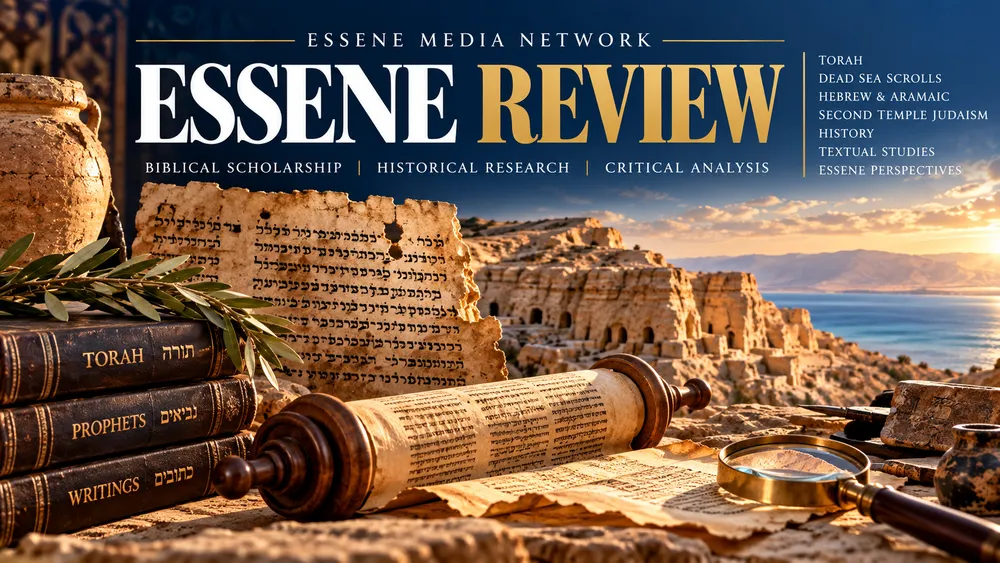
Examining ancient manuscripts, recovering historical context, and distinguishing the written evidence from centuries of interpretation.
A New Publication Dedicated to the Search for Truth
The history of Israel, the preservation of the Hebrew Scriptures, and the development of Jewish thought constitute one of humanity's most remarkable intellectual and religious inheritances.
Yet the understanding of this inheritance has not remained unchanged.
Throughout the centuries, sacred writings have been translated into different languages, interpreted through changing cultural environments, and understood according to the traditions of successive generations. Historical circumstances, political developments, and religious institutions have influenced how ancient texts are read and explained.
For the serious student of Scripture, these developments raise important questions.
What did the original Hebrew and Aramaic texts communicate to their earliest audiences? How did Jewish communities understand the Torah during the Second Temple period? What can ancient manuscripts reveal about interpretations that existed before later religious traditions became established? And how can historical evidence help distinguish the original context of a passage from interpretations introduced afterward?
These questions stand at the center of Essene Review, a publication of Essene Media Network dedicated to biblical scholarship, historical investigation, textual examination, and informed critical analysis.
Our purpose is to encourage readers to examine the evidence, understand the historical setting, and approach the sacred writings with intellectual honesty and respect for their ancient Israelite and Jewish foundations.
Returning to the Historical Foundations of Scripture
The Hebrew Scriptures emerged within the history, language, geography, and covenantal experience of ancient Israel.
Their teachings cannot be adequately understood when separated from these foundations.
The Torah, the Prophets, and the Writings contain laws, historical accounts, poetry, wisdom instruction, prophetic declarations, and covenantal obligations. Each literary form requires careful attention to its language and original setting.
An ancient legal instruction must be examined within its covenantal and judicial context. A prophetic declaration must be considered in relation to the historical circumstances confronting its audience. Poetry and figurative language must be understood according to their literary character.
Essene Review approaches these writings through close textual study, historical investigation, and comparison with relevant ancient sources.
Our aim is not to impose modern assumptions upon ancient texts, but to investigate what those texts communicated within their original linguistic and cultural environments.
As Proverbs 18:13 teaches, answering a matter before hearing it is folly and shame.
Careful examination must precede confident conclusions.
The Dead Sea Scrolls: A Window into Ancient Judaism
Among the most important archaeological discoveries of the twentieth century are the Dead Sea Scrolls, recovered from caves in the vicinity of Qumran beginning in 1947.
These manuscripts transformed the study of the Hebrew Scriptures and Second Temple Judaism.
The collection includes biblical manuscripts, scriptural commentaries, legal discussions, communal regulations, hymns, prayers, wisdom writings, and calendrical documents.
Their significance extends beyond the preservation of ancient texts. They demonstrate the diversity of Jewish religious thought during the centuries surrounding the late Second Temple period.
Several manuscripts are especially important to the research undertaken by Essene Review.
The Community Rule — 1QS
The Community Rule, also known as Serekh ha-Yahad, describes the organization and conduct of a covenantal community.
It addresses communal admission, instruction, discipline, purity, obedience, and the pursuit of truth and righteousness.
The text provides evidence of how one ancient Jewish community understood its responsibility to preserve covenantal faithfulness.
The Damascus Document — CD
The Damascus Document preserves instruction concerning covenantal obligations, communal organization, legal interpretation, and the correction of wrongdoing.
It offers important evidence concerning the relationship between Torah observance, communal discipline, and the interpretation of sacred instruction.
Some Works of the Law — 4QMMT
The manuscripts collectively known as Miqsat Ma'ase ha-Torah, or Some Works of the Law, preserve discussions of legal matters that were disputed among Jewish groups.
They are particularly valuable for understanding the diversity of legal interpretation during the Second Temple period.
The Habakkuk Commentary — 1QpHab
The Habakkuk Commentary demonstrates how an ancient community interpreted prophetic Scripture in relation to its own historical circumstances.
This form of interpretation, commonly called pesher, provides important evidence for understanding the relationship between prophetic writings and contemporary events in Second Temple Jewish thought.
These manuscripts are studied as historical witnesses. Their contents must be examined individually rather than treated as though every manuscript represents a single, uniform doctrine.
Although many scholars associate the Qumran community with the Essenes described by ancient historians, the precise relationship remains a subject of academic discussion.
Essene Review will distinguish the evidence contained in the manuscripts from historical reconstructions and contemporary Essene interpretations.
Hebrew and Aramaic: Recovering the Meaning of Ancient Words
Language is fundamental to the interpretation of Scripture.
The Hebrew language contains grammatical structures, idioms, poetic expressions, and legal terminology that cannot always be reproduced precisely in another language.
Aramaic, widely used in parts of the ancient Near East and among Jewish populations during the Second Temple period, is likewise essential for understanding the historical environment of many Jewish writings.
A translation may communicate the general meaning of a passage while leaving important linguistic distinctions unexplained.
For this reason, Essene Review will examine significant passages through several complementary stages:
- The exact wording: Identifying the words, grammar, and structure of the surviving text.
- The ancient linguistic context: Investigating idioms and expressions familiar to Hebrew- and Aramaic-speaking audiences.
- The plain meaning: Explaining the passage clearly without introducing ideas unsupported by its wording.
- The historical and covenantal significance: Considering how the passage relates to the Torah, the Prophets, and the documented religious world of ancient Judaism.
Where manuscripts differ, those differences will be acknowledged. Where a translation is uncertain, readers will be informed.
The purpose is not to manufacture certainty, but to pursue the most responsible understanding permitted by the evidence.
Examining the Development of Religious Interpretations
Religious interpretations do not develop in isolation.
They emerge within communities, institutions, historical circumstances, and intellectual traditions.
During the Second Temple period, Jewish groups differed in their understanding of priestly authority, purity regulations, sacred calendars, legal interpretation, and communal responsibilities.
Following the destruction of the Second Temple in 70 CE, Jewish religious life underwent significant institutional and interpretive developments.
Other religious traditions also developed their own understandings of Israel's Scriptures, often reading ancient texts through later theological frameworks.
Essene Review will examine these developments historically and critically.
Our investigations will distinguish among three essential categories:
The original textual evidence: What the surviving manuscripts actually contain.
Historical interpretation: How ancient communities and later interpreters understood those writings.
Contemporary doctrinal claims: How present-day religious communities apply or reinterpret the texts.
These categories must not be confused.
An interpretation may possess a long history without necessarily representing the earliest recoverable meaning of a passage. Conversely, an interpretation proposed today requires evidence before it can be presented as an authentic ancient teaching.
Our commitment is to evaluate such claims through documented sources, linguistic analysis, and historical context.
The Essene Perspective and the Covenant of Israel
Essene Review approaches its work from a Torah-centered Essene perspective.
Within this understanding, the covenant of Israel remains the foundational framework for interpreting sacred instruction.
The Torah establishes the responsibilities of righteousness, justice, holiness, and faithfulness. The Prophets repeatedly call Israel to return to those obligations.
Deuteronomy 30:11–14 emphasizes that the commandment is not beyond reach, but is near enough to be heard, understood, and practiced.
Jeremiah 6:16 calls the people to seek the ancient paths and walk in the good way.
These passages express a central concern of the Essene Way: the recovery and faithful practice of covenantal instruction.
At the same time, a contemporary Essene interpretation must be identified as such. Historical evidence and modern restoration teachings are related subjects, but they are not interchangeable.
Our publication will seek to preserve this distinction while presenting the principles and perspectives of Essene Judaism.
The Historical World of the Second Temple
Understanding ancient Judaism requires more than studying individual passages.
It requires investigating the world in which those passages were preserved, interpreted, and debated.
Essene Review will explore the historical circumstances of Judea, Galilee, Samaria, and the wider Jewish diaspora under successive imperial powers.
Particular attention will be given to the Babylonian, Persian, Hellenistic, Hasmonean, and Roman periods.
Our research will examine the development of Jewish institutions, the role of the priesthood, disputes over Temple authority, the influence of political power, and the emergence of distinct Jewish movements.
We will also consider the writings of ancient historians such as Josephus and Philo of Alexandria, evaluating their testimony in relation to archaeological discoveries and surviving manuscripts.
Historical accounts will be assessed according to their sources, chronology, literary purpose, and possible limitations.
The goal is to reconstruct the ancient setting as accurately as the available evidence permits.
Archaeology, Manuscripts, and Historical Discovery
Archaeology continues to contribute to our understanding of ancient Israel and the broader Near East.
Inscriptions, manuscripts, coins, seals, architecture, burial practices, and material remains can illuminate aspects of history that written accounts leave incomplete.
However, archaeological discoveries must be interpreted carefully.
An artifact may establish the existence of a settlement, a name, an administrative practice, or a historical activity without proving every claim associated with it.
Essene Review will therefore examine archaeological discoveries according to their documented provenance, dating, publication history, and scholarly interpretation.
When a discovery is preliminary, disputed, or insufficiently documented, those limitations will be clearly stated.
The importance of a historical discovery should be determined by the strength of its evidence, not by the excitement surrounding its announcement.
Introducing Responses and Clarifications
One of the distinctive features of Essene Review will be Responses and Clarifications, a section devoted to examining commonly repeated religious and historical claims.
This section will address questions concerning biblical interpretation, the history of Jewish religious movements, the Dead Sea Scrolls, ancient languages, and the development of later doctrines.
Its purpose is not to promote hostility toward other communities.
Rather, it will provide reasoned responses supported by textual evidence, historical documentation, and clear argumentation.
Where disagreement exists, the competing positions will be represented accurately before being evaluated.
Readers should be able to distinguish what a source states, what an interpreter concludes, and where reasonable uncertainty remains.
A responsible examination of history requires both conviction and intellectual discipline.
What Readers Can Expect from Essene Review
Essene Review will develop a growing collection of original research articles, educational studies, manuscript examinations, historical essays, and critical reviews.
Our principal areas of investigation will include:
- Biblical Studies: Close examination of the Torah, Prophets, and Writings.
- Qumran Research: Study of the Dead Sea Scrolls and related manuscripts.
- Hebrew and Aramaic: Translation, grammar, idioms, and textual interpretation.
- Second Temple Judaism: Historical institutions, communities, and religious developments.
- Essene Doctrine: The covenantal principles and contemporary understanding of the Essene Way.
- Comparative Studies: Historical examination of differing religious interpretations.
- Responses and Clarifications: Evidence-based analysis of disputed claims.
- Book Reviews: Critical assessment of publications relevant to biblical and Jewish historical scholarship.
We intend to make complex subjects accessible without sacrificing accuracy.
Readers will be encouraged to examine primary sources, consider historical context, and distinguish well-established evidence from speculation.
Scholarship in the Service of Understanding
The search for historical truth requires patience.
Ancient manuscripts are sometimes incomplete. Words may be damaged or uncertain. Archaeological evidence may permit more than one interpretation. Historical writers may disagree, and modern scholars may reach different conclusions from the same evidence.
These realities do not diminish the value of research. They make responsible investigation all the more necessary.
Essene Review will approach such questions with a commitment to transparency, careful documentation, and reasoned examination.
Our purpose is not simply to accumulate information, but to deepen understanding of the ancient covenantal heritage of Israel and the historical circumstances through which that heritage has been transmitted.
An Invitation to Examine the Evidence
Essene Review begins with a conviction that the study of Scripture and history deserves seriousness, integrity, and intellectual honesty.
We invite students, educators, historians, researchers, and interested readers to join us in examining the ancient sources, exploring their historical setting, and considering their significance.
The inheritance of Israel is too important to be approached carelessly, and the historical testimony of the ancient world deserves more than superficial interpretation.
Through scholarship, careful reasoning, and fidelity to the evidence, we seek to contribute to a more informed understanding of the Torah, Second Temple Judaism, and the Essene Way.
Essene Review — Examine the Text. Investigate the History. Understand the Covenant.
Essene Review is a publication of Essene Media Network, an official media platform of the United Community of Essene Judaism (UCEJ).
Foundational Sources and Recommended References
Hebrew Scriptures
- Deuteronomy 30:11–14 — The accessibility and practice of divine instruction
- Proverbs 18:13 — The importance of hearing before answering
- Jeremiah 6:16 — The ancient paths and the good way
Dead Sea Scrolls
- 1QS I–V — Community Rule: covenant, instruction, and communal organization
- CD VI–VII — Damascus Document: covenantal instruction and community conduct
- 4Q394–399 — Some Works of the Law (4QMMT): disputed legal interpretations
- 1QpHab — Commentary on Habakkuk: prophetic interpretation
- 11Q19 — Temple Scroll: Temple regulations and legal instruction
- 4QInstruction (4Q415–418 and related manuscripts) — Wisdom and ethical instruction
Ancient Historical Sources
- Josephus, The Jewish War, II.119–161
- Josephus, Jewish Antiquities, XVIII.18–22
- Philo of Alexandria, Every Good Man Is Free, 75–91
Scholarly Editions
- García Martínez, Florentino, and Eibert J. C. Tigchelaar. The Dead Sea Scrolls Study Edition. 2 vols. Brill, 1997–1998.
- Vermes, Geza. The Complete Dead Sea Scrolls in English. Revised edition. Penguin, 2004.
- Charlesworth, James H., ed. The Dead Sea Scrolls: Hebrew, Aramaic, and Greek Texts with English Translations. Volume 1: Rule of the Community and Related Documents. Westminster John Knox Press, 1994.
- Qimron, Elisha, and John Strugnell. Qumran Cave 4.V: Miqsat Ma'ase ha-Torá. Clarendon Press, 1994.


